President Donald Trump has proposed eliminating federal income taxes in favor of a tariff-based economic system, citing the period from 1870 to 1913 as a model for increasing American wealth. He suggests creating a new agency, the External Revenue Service (ERS), to manage tariffs and foreign revenue, aiming to reduce the tax burden on U.S. citizens.
Trump’s Vision for a Tariff-Based Economy
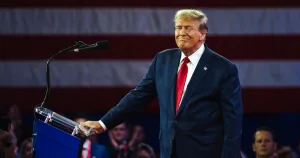
Speaking at the 2025 Republican Issues Conference at Trump National Doral Miami on January 27, Trump outlined his economic proposal before a gathering of GOP leaders. The three-day event, as reported by AFP, was aimed at shaping his legislative agenda.
During his speech, Trump pointed to historical precedent, arguing that prior to 1913, the United States thrived without an income tax, relying instead on tariffs. He described this period, spanning from 1870 to 1913, as one of the nation’s most prosperous eras.
“You know, from 1870 to 1913, the U.S. operated entirely on tariffs—and that was the richest period in American history, relatively speaking,” he claimed. He referenced the Tariff Commission of 1887, asserting that it was tasked with determining how to manage the vast sums of money collected through tariffs.
“It was so enormous that they had no idea what to do with all of the money. Teddy Roosevelt, as a beneficiary, was able to fund national parks and other projects—all through tariffs. There was no income tax; that only came in 1913,” Trump added.
‘Tax Foreign Nations, Not Our Citizens’
Trump argues that instead of taxing American citizens to benefit foreign nations, the U.S. should impose tariffs on foreign countries to enrich its own citizens. He believes that a tariff-centric approach will make America “very rich again” and that it can happen “very quickly.”
Trump has long championed the idea of replacing income taxes with tariffs, a stance he maintained throughout his campaign for the presidency.
Could the U.S. Replace Income Tax with Tariffs?
Tariffs, which are typically levied as a percentage of the price of imported goods, are collected at ports of entry by U.S. Customs and Border Protection agents. However, mainstream economists remain skeptical of tariffs as a primary revenue source, arguing that they are an inefficient means of funding government programs and could ultimately lead to higher costs for consumers.
However, this proposal has sparked debate among economists and policymakers. Critics argue that tariffs are essentially taxes on imports, which are often passed on to consumers in the form of higher prices. This could disproportionately affect lower- and middle-income households, potentially negating any benefits from the elimination of income taxes.
Additionally, there are concerns about the practicality of funding the federal government solely through tariffs. Estimates suggest that a 10% tariff could generate $350 to $400 billion annually, which falls short of covering the $4 trillion cost of extending current tax cuts over ten years. This shortfall might necessitate substantial cuts to programs like Social Security and Medicare to balance the budget.
The External Revenue Service Proposal
Trump’s proposal includes the creation of a new agency, the External Revenue Service (ERS), to oversee tariffs and foreign trade revenues. However, establishing such an agency would require congressional approval. With Republicans controlling both the House and Senate, the plan could gain legislative traction.
The initiative has raised questions about government expansion, as Trump—who has pledged to reduce federal bureaucracy—would be forming an agency to handle duties already managed by existing entities like the Commerce Department and U.S. Customs and Border Protection. The proposed External Revenue Service would focus on collecting revenue from foreign sources, distinguishing it from the current Internal Revenue Service, which handles domestic taxes.
Major Tariffs at the Core of Trump’s Economic Plan
As part of his broader economic strategy, Trump has proposed steep tariffs, including a potential 25% levy on imports from allies like Canada and Mexico and a 60% tariff on Chinese goods. These measures are designed to bolster domestic revenue and shift the tax burden away from American citizens.
However, economists warn that such tariffs would likely increase consumer prices, as businesses pass costs down to buyers. Many experts remain skeptical, arguing that tariffs are an inefficient means of generating government revenue and fostering economic growth.
In summary, while the proposal aims to reduce the tax burden on American citizens and increase national wealth through tariffs, it raises significant concerns about economic impact, feasibility, and potential effects on consumers and government programs.